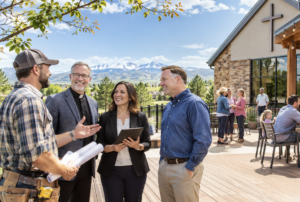
Churches have always been places where people come together for more than Sunday worship. Fellowship meals, youth activities, Bible studies, holiday celebrations, and community outreach programs all contribute to the relationships that make a congregation feel like family. In Parker, Colorado, creating welcoming outdoor gathering spaces can give churches additional opportunities to bring people together while making better use of their existing property.
A thoughtfully designed deck can provide a comfortable setting for conversations after Sunday services, outdoor prayer meetings, small-group gatherings, and special church events. However, building a deck for a church involves considerations that differ from those of a typical residential backyard project. Accessibility, structural safety, congregation size, local building requirements, and long-term maintenance all deserve careful attention.
For churches considering an outdoor improvement project, choosing a qualified deck builder is about more than finding someone who can construct an attractive platform. It means finding a contractor who understands how the space will be used, recognizes the importance of safety, and can help church leaders make informed decisions about their investment.
The following considerations can help Parker-area churches plan an outdoor gathering space that serves their congregation and surrounding community for years to come.
Why Outdoor Gathering Spaces Matter for Colorado Churches
Church fellowship does not end when the Sunday sermon concludes. Some of the most meaningful conversations happen afterward, when families catch up, visitors meet longtime members, and people take the time to encourage one another.
An outdoor deck can provide a natural extension of a church’s existing fellowship areas. Instead of having everyone gather in a crowded hallway or multipurpose room, a congregation can offer an additional place where people can sit, talk, and enjoy the outdoors.
The Colorado Council of Churches emphasizes the value of Christian communities working together through worship, service, advocacy, and action. Although each congregation approaches ministry differently, creating places where people feel welcome can support those broader goals.
For churches with active children’s ministries, outdoor spaces may also provide useful settings for supervised activities, family gatherings, and special seasonal programs. Youth groups could use a properly designed deck for small-group discussions, while adult ministries might appreciate a peaceful setting for prayer or fellowship.
A church does not necessarily need an elaborate outdoor entertainment area to make a meaningful difference. Sometimes a modest, well-designed deck with comfortable seating and appropriate shade can become a regularly used part of church life.
Understanding the Unique Needs of a Church Deck Project
A deck designed for a private residence may only need to accommodate a family and occasional guests. A church deck, on the other hand, could be used by dozens of people during a fellowship event or community gathering.
That difference affects the planning process considerably.
Church leaders should begin by identifying the activities they expect to take place on the deck. A quiet outdoor prayer area will have different structural and layout requirements from a large fellowship space used for gatherings, tables, and chairs.
The expected number of occupants is particularly important. A qualified designer or contractor should establish the appropriate occupancy classification, design loads, and applicable building requirements rather than relying on residential deck assumptions.
Access to the church building also deserves attention. A deck connected to an existing fellowship hall may need to accommodate doorways, exterior walkways, emergency exits, and existing utilities.
Churches should consider how people will move between the building, parking areas, and outdoor gathering space. A beautiful deck can become inconvenient if visitors must cross uneven landscaping or navigate narrow passages to reach it.
The most successful design will balance appearance with the practical needs of the congregation.
Parker, Colorado Building Permits and Church Construction Requirements
Before construction begins, church leaders should understand the local permitting process.
According to the Town of Parker Building Division, building permits and inspections help confirm that construction meets applicable requirements. The town states that permits are required for decks regardless of their height or size.
However, churches should not assume that the same rules governing a residential backyard deck automatically apply to their property. Religious facilities may have different occupancy classifications, accessibility considerations, zoning requirements, and fire-safety obligations.
The town’s building permit information explains the local application process and contractor licensing requirements. Contractors working within incorporated Parker must be appropriately licensed with the town.
Churches located outside Parker’s incorporated boundaries may fall under a different permitting authority, even when they use a Parker mailing address. Confirming jurisdiction before preparing plans can help prevent confusion and unnecessary delays.
For a church planning an outdoor addition, it is particularly important to establish who will handle the drawings, permit applications, engineering requirements, inspections, and communication with local officials.
A contractor’s willingness to discuss these responsibilities clearly is a meaningful part of evaluating their professionalism.
Accessibility Should Be Part of the Design From the Beginning
Church fellowship should be welcoming to people of different ages and physical abilities. An outdoor gathering space should reflect that commitment.
A raised deck may create challenges for wheelchair users, older members, or visitors with mobility limitations if accessible routes are not incorporated into the design.
The 2010 ADA Standards for Accessible Design provide technical requirements for accessible facilities and routes. Religious organizations have certain exemptions under federal ADA provisions, but other applicable state and local accessibility or building requirements may still affect a construction project.
For Parker churches, accessibility planning may involve ramps, appropriate walking surfaces, suitable entrances, and enough room for people using mobility devices to participate comfortably.
Accessibility should not be viewed merely as a construction requirement. It is also an opportunity to make the church’s outdoor environment more inviting.
A congregation that includes older adults, young families with strollers, and members with disabilities may benefit greatly from a gathering area designed around practical access and ease of movement.
Discussing these needs before construction begins is generally easier than attempting to correct accessibility problems after the deck has been completed.
Choosing Materials That Can Handle Colorado’s Changing Weather
Colorado weather can be beautiful, but it also presents challenges for outdoor structures.
Parker experiences strong sunlight, winter snow, freezing temperatures, and periods of rapid temperature change. These conditions should influence both the materials selected and the way the deck is constructed.
Traditional pressure-treated lumber remains one option for deck framing and certain exterior applications. Wood decking can offer a familiar appearance, but it generally requires periodic maintenance to help protect it from weather-related wear.
Composite decking is another option. Many composite products are designed to resist moisture-related deterioration and reduce routine staining requirements, although maintenance needs and performance vary by manufacturer.
Neither option is automatically the best choice for every church.
A congregation with limited maintenance resources may prioritize materials that require less frequent attention. Another church might prefer the appearance of natural wood and already have volunteers or maintenance personnel available for ongoing upkeep.
Structural framing, drainage, fastening systems, and surface traction are just as important as the visible decking material.
Church leaders should also consider the surrounding landscape. Snowmelt, irrigation, roof drainage, and water collecting near foundations can affect the long-term condition of outdoor structures.
The goal should be to select materials and construction methods suited to the actual site, anticipated use, maintenance budget, and applicable building standards.
Safety Considerations for Large Church Gatherings
Safety deserves particular attention when a deck will serve as a shared space for church events.
A deck that regularly accommodates multiple families, groups of children, or larger gatherings requires careful structural planning. Railings, stairs, foundations, connections, and the overall layout must be appropriate for the intended use.
The location of outdoor furniture, tables, and gathering areas can also affect circulation and emergency access.
Churches should avoid placing outdoor additions where they interfere with existing exit doors, emergency routes, or access needed by first responders.
South Metro Fire Rescue is responsible for applicable fire-code plan reviews, construction permits, and inspections within its service area. In Parker, fire-code administration transitioned to South Metro Fire Rescue in July 2025.
Depending on the project, fire officials may need to evaluate elements of the proposed construction.
Outdoor lighting also deserves consideration. Evening fellowship events, youth gatherings, and seasonal celebrations may continue after sunset. Properly placed lighting can help people recognize changes in elevation, navigate steps, and move safely between buildings.
For churches serving children and families, thoughtful safety planning can help make the outdoor space more comfortable for everyone.
How an Outdoor Deck Can Support Church Fellowship and Community Outreach
A deck is not simply another construction project. When designed around the needs of a congregation, it can become a useful setting for everyday ministry.
Imagine a Sunday morning when families remain after worship to enjoy coffee and conversation outside. New visitors have a relaxed opportunity to meet church members, while children enjoy time with their families nearby.
During the week, the same area might accommodate a small Bible study, a ministry team meeting, or a gathering of volunteers preparing for an outreach program.
Churches may also find that outdoor gathering areas complement existing fellowship halls, gardens, and recreation spaces.
The history and development of Parker, Colorado, reflect its place within the growing communities of Douglas County. Local congregations serve families with varied schedules, interests, and needs, making flexible gathering spaces particularly useful.
An outdoor deck could support church picnics, appreciation events for volunteers, community meals, or seasonal activities when weather permits.
The specific activities will depend on each congregation’s mission, property, and resources. Still, the broader purpose remains the same: creating additional opportunities for people to connect.
Finding a Local Deck Builder Who Understands Parker Properties
Local experience can be helpful when planning a project affected by regional weather, building requirements, and site conditions.
A contractor familiar with Parker may have experience working with sloped properties, outdoor construction materials, and local permitting procedures.
Church representatives researching options can review Parker Deck Builder Near Me to learn about Bulldog Builders, a Colorado contractor advertising deck construction and outdoor improvement services in Parker and surrounding communities.
Bulldog Builders describes its services as including custom deck design and construction, along with pergolas and other improvement projects.
For church leaders, this type of local resource can be a starting point for exploring potential designs and gathering information about available services.
However, experience with residential decks should not automatically be treated as proof of qualifications for a church or other assembly-use project. Before hiring any contractor, a congregation should confirm relevant licensing, insurance, structural design capabilities, references, and experience with the specific type of construction being proposed.
Written estimates should clearly identify the project scope, materials, responsibilities, payment terms, anticipated schedule, and treatment of changes during construction.
Church boards and property committees benefit from having this information documented before making a financial commitment.
Planning a Church Deck Around Stewardship and Long-Term Value
For many churches, every major expenditure must be considered carefully. Construction projects may be funded through designated building funds, donations, capital campaigns, or money set aside for property improvements.
A deck should therefore be evaluated not only by its initial construction price but also by the long-term responsibilities it creates.
Less expensive materials may have different maintenance requirements from higher-priced alternatives. Features such as shade structures, exterior lighting, additional stairs, and built-in seating can influence the overall project cost.
Church leaders should distinguish between features that are essential for safety and accessibility and features that can be added later.
A well-prepared proposal should give decision-makers enough information to compare options without overlooking important expenses.
The Town of Parker’s building forms and regulations provide useful guidance for understanding construction documentation and local requirements. While residential deck handouts may offer general background, commercial and assembly-use projects should be evaluated under the rules applicable to the specific property.
Long-term stewardship also includes inspection and maintenance after construction. Deck surfaces, railings, connections, and stairs should be monitored for wear and deterioration, particularly after severe weather.
A gathering space that remains safe, functional, and attractive over time can provide greater value than one selected primarily because of its initial price.
Creating an Outdoor Space That Reflects the Church’s Mission
Every congregation has its own character. Some churches emphasize large fellowship gatherings, while others maintain smaller, quieter spaces where members can pray, reflect, or talk privately.
The design of an outdoor deck should reflect those differences.
A church with an active family ministry may prefer open space that accommodates tables and flexible seating. A congregation with many older members may value comfortable access, shade, and places to sit and enjoy conversations.
A church surrounded by attractive landscaping might want a design that complements the existing grounds without overwhelming them.
The location, size, and appearance of the deck should work with the church property rather than compete with it.
For some congregations, a simple outdoor platform adjoining the fellowship hall will meet their needs. Others may benefit from a larger design incorporating seating areas, a pergola, or connections to existing walkways.
The right approach begins with a clear understanding of how the congregation intends to use the space.
When church leaders communicate those priorities to a qualified contractor, they can make better decisions about design, materials, safety, and budget.
Conclusion: Building Outdoor Spaces That Bring Parker Churches Together
An outdoor deck can offer much more than additional square footage for a church. It can become a place where friendships develop, visitors feel welcome, families spend time together, and ministry activities extend beyond the sanctuary walls. ⛪
For churches in Parker, Colorado, the decision to build should begin with thoughtful planning. Local permitting requirements, accessibility, structural safety, weather-resistant materials, and long-term maintenance all deserve attention before construction starts.
Choosing the right deck builder is equally important. Church leaders should look for a contractor who communicates clearly, understands the intended use of the space, and can demonstrate the qualifications needed for the proposed project.
A carefully planned outdoor gathering area can serve a congregation through Sunday fellowship, community outreach, special celebrations, and ordinary conversations that help build lasting relationships.
Ultimately, the value of a church deck is not measured only by the materials used or the size of the finished structure. Its value can also be found in the people who gather there, the relationships it helps nurture, and the opportunities it creates for a church to welcome and serve its community.
Leave a Reply