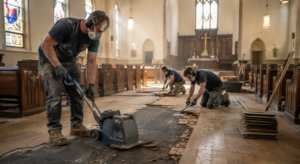
Church buildings carry a unique kind of history. Generations of families may have worshiped in the same sanctuary, children may have grown up running through the fellowship hall, and countless weddings, funerals, baptisms, holiday services, and community events may have taken place under the same roof. ⛪
That history gives church facilities tremendous meaning, but it does not stop those buildings from aging. Carpet wears down, tile becomes cracked or dated, adhesives deteriorate, and flooring installed decades ago may no longer serve the needs of a modern congregation. As churches renovate sanctuaries, classrooms, fellowship halls, offices, and multipurpose spaces, professional flooring removal has become an increasingly important part of the process.
Church renovation is about much more than improving appearances. It is an opportunity to care for a facility that serves worshipers, ministry teams, visitors, children, and the surrounding community. For many congregations, that means hiring experienced flooring removal companies rather than attempting to handle a large flooring demolition project with volunteers or a general maintenance crew.
Church Buildings Continue to Play an Important Role in Congregational Life
The role of the physical church building has changed throughout Christian history, but dedicated worship spaces remain important gathering places for millions of people. The development of church architecture described by Wikipedia demonstrates just how much the design and use of Christian worship spaces have evolved over the centuries.
Today, churches may include much more than a traditional sanctuary. A single facility can contain classrooms, administrative offices, kitchens, gymnasiums, fellowship halls, nurseries, youth areas, auditoriums, cafés, meeting rooms, and community outreach spaces.
Those facilities experience considerable foot traffic.
According to Pew Research Center research on religious attendance and congregational involvement, millions of Americans continue to participate in religious services and congregational life. Church buildings may also be used throughout the week for Bible studies, recovery programs, food distribution, youth activities, weddings, funerals, counseling, meetings, and other ministries.
With that much activity, flooring eventually shows its age.
A worn floor can make an otherwise well-maintained church look neglected. More importantly, damaged or deteriorating flooring can interfere with how comfortably and efficiently the building functions.
Church Renovations Often Begin at Floor Level
Flooring has a tremendous visual impact because it extends throughout such a large portion of a building. Even small flooring improvements can dramatically change how a room feels.
Old carpeting may make a sanctuary appear darker or more dated. Damaged tile can distract from an otherwise attractive fellowship hall. Flooring installed decades earlier may clash with new paint, lighting, seating, technology, or architectural improvements.
This is one reason flooring projects frequently become part of larger church renovation plans.
Christianity Today’s coverage of church buildings reflects the ongoing importance of physical facilities to congregations and the variety of ways churches are adapting, restoring, purchasing, preserving, and rethinking their properties.
Before attractive new flooring can be installed, however, the existing material often has to come out.
That portion of the project can be far more involved than it initially appears.
Removing Church Flooring Can Become a Major Project
Pulling up a small section of residential carpet is one thing. Removing flooring across thousands of square feet of church property is something entirely different.
Church facilities often contain several flooring materials installed during different periods of the building’s history. Carpet may cover one area while tile, vinyl, hardwood, laminate, or another material appears elsewhere.
Underneath those surfaces may be adhesive, thinset, coatings, residue, or other materials that must also be addressed before the new floor can be properly installed.
The size of church facilities adds another challenge.
A sanctuary alone can represent a substantial amount of floor space. Add hallways, classrooms, offices, fellowship areas, entryways, and other rooms, and a flooring renovation can quickly become a large demolition and preparation job.
Professional equipment can make the removal process considerably more efficient while helping prepare the underlying surface for whatever comes next.
That preparation matters because the condition of the substrate can influence the success of the new flooring installation.
Professional Removal Can Help Churches Protect Their Renovation Investment
Church renovation budgets are usually carefully managed. Congregations may spend months or even years planning improvements, raising funds, gathering estimates, and deciding which projects should receive priority.
The goal should not simply be to get the old floor out as cheaply as possible. The goal should be to create the proper foundation for the new flooring that the church is paying to install.
Incomplete adhesive removal, uneven surfaces, and damage caused during demolition can create additional work for flooring installers.
Professional removal crews typically approach the job with equipment and methods designed specifically for flooring demolition and surface preparation. This can help create a cleaner transition between removal and installation.
For churches, that can mean fewer surprises during a renovation that may already involve painters, electricians, seating companies, audio-visual contractors, flooring installers, and other trades.
Good coordination becomes especially valuable when a congregation is trying to complete work between Sunday services or during a limited renovation window. 🛠️
Churches Have More Complicated Scheduling Needs Than Many Commercial Buildings
Closing a church for several weeks is rarely practical.
Sunday services continue. Ministries continue. Staff members need access to offices. Weddings may already be scheduled. Community organizations may use the facility. Children and youth programs may operate throughout the week.
This creates a strong incentive to complete disruptive renovation work as efficiently as possible.
Professional flooring removal may allow a church to divide the project into manageable phases or complete substantial areas during periods when the facility is less active.
Current reporting from Religion News Service regularly illustrates the broad range of ministries, congregational activities, and community roles connected with churches across the country. Those activities do not simply disappear because a building needs renovation.
For a church leadership team, maintaining ministry operations while improving the facility requires careful planning.
Floor removal is one of those jobs where specialized expertise can make that planning easier.
Older Churches Require Additional Attention Before Flooring Is Disturbed
Some churches have occupied the same property for generations. Others have purchased older buildings and adapted them for ministry.
Age adds character, but it can also add uncertainty.
Church leaders may not know exactly when every floor was installed, what products were used underneath it, or how many times flooring has been replaced over the years.
Older buildings can contain materials that require additional evaluation before renovation begins. Church leaders and contractors should identify questionable materials and follow applicable safety requirements rather than simply beginning demolition.
Historic churches present another consideration because architectural elements may need to be preserved during modernization.
Churches around the world continue to balance preservation with present-day needs. Vatican News church coverage frequently documents the continuing life of historic Christian communities and worship spaces, reinforcing how closely church facilities can be connected with heritage, faith, and community identity.
Professional renovation should respect that connection.
Modernizing a church does not require stripping away everything that gives the building its character. In many cases, updated flooring actually allows distinctive architectural features to stand out more clearly.
Cleaner, Updated Floors Can Improve the Welcome Experience
A church does not need to resemble a luxury hotel or entertainment venue to make visitors feel welcome.
It does need to look cared for.
People notice their surroundings when they enter an unfamiliar building. They see the entrance, lighting, seating, restrooms, signage, walls, and floors before the service even begins.
Updated flooring can make a church feel brighter, cleaner, and better maintained without changing its spiritual identity.
This matters beyond Sunday morning.
Many churches want their buildings to serve their communities throughout the week. Fellowship halls may host meals and support groups. Classrooms may be used for tutoring. Large spaces may accommodate conferences, blood drives, charitable programs, or disaster response efforts.
Churches have long served as community gathering places, and reporting by The Associated Press on religion and churches continues to document the many ways faith communities interact with the broader world.
Maintaining the building is therefore not simply about appearances. It is part of maintaining a useful community asset.
Different Church Spaces Need Different Flooring Solutions
One reason church flooring renovations can become complex is that every area does not necessarily need the same material.
A sanctuary may benefit from flooring that supports acoustics and creates a warm atmosphere. Entryways require materials capable of handling dirt, moisture, and heavy traffic. Nurseries and children’s areas may prioritize comfort and easy cleaning. Fellowship halls need durable surfaces that can withstand tables, chairs, meals, and frequent events.
Church offices have different requirements, and multipurpose rooms may need flooring capable of supporting everything from worship services to recreation.
Before installation can begin, each existing surface may require a different removal approach.
A church with several additions constructed over decades may discover entirely different flooring systems as crews move from one part of the facility to another.
That is another reason specialized removal services can be valuable. The work is not always one repetitive process performed across an entire building.
Renovation Can Be Part of Responsible Church Stewardship
Church leaders constantly make decisions about how to use limited resources responsibly.
A roof replacement may not sound exciting, but ignoring a leaking roof eventually becomes far more expensive. The same principle applies to HVAC systems, plumbing, electrical systems, parking areas, and interior finishes.
Flooring is part of that responsibility.
Waiting until surfaces become severely damaged can turn a planned renovation into an urgent repair.
Churches that maintain their properties proactively can often schedule improvements around ministry activities and budget for them in advance.
Resources such as Christianity Today’s architecture coverage also demonstrate how much thought churches continue to give to the relationship between physical space, worship, community, and ministry.
A building is not the Church itself, but the building can support the work taking place inside it.
Caring for that facility can therefore be viewed as practical stewardship rather than simple decoration.
Professional Flooring Removal Helps Prepare the Church for What Comes Next
The exciting part of a flooring renovation is usually seeing the finished product.
Congregation members notice the new carpet. Visitors see the new tile. Staff members appreciate refreshed offices. Church leaders finally see a project that may have been discussed for years become reality. 🙏
The demolition stage receives far less attention, but it creates the foundation for everything that follows.
Removing old flooring correctly can help installers begin with a properly prepared surface rather than spending valuable project time correcting problems left behind during demolition.
That becomes particularly important on larger church projects where delays in one area can affect multiple contractors and installation schedules.
Church renovations represent a significant investment of money, time, planning, and often volunteer effort. Starting that investment with professional preparation can help the remainder of the project move forward more smoothly.
Conclusion
Church buildings are places where people worship, celebrate, grieve, learn, serve, gather, and build relationships. Some are historic sanctuaries that have served communities for generations. Others are modern facilities designed around growing ministries and changing community needs.
Every one of them eventually requires maintenance.
As churches update aging facilities, flooring removal is becoming an important first stage of many renovation projects. Large square footage, multiple flooring materials, old adhesives, busy ministry schedules, and the need for proper surface preparation can make professional removal far more practical than approaching the work as a simple demolition project.
The finished floor may be what everyone sees when the church doors reopen, but the quality of a renovation often depends on the work completed before that new floor ever arrives.
For congregations investing in their facilities, professional flooring removal can help create a cleaner beginning for the next chapter of the church building and the generations that will continue gathering there. ⛪
Leave a Reply