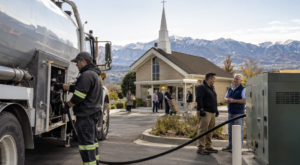
Churches throughout the Salt Lake Valley are more than places where people gather for worship. They are meeting places, volunteer centers, food collection points, emergency support locations, youth activity centers and gathering spaces where neighbors routinely come together to serve one another. Across Utah, faith and community service have long been closely connected, particularly along the Wasatch Front and throughout the Salt Lake area.
Keeping those ministries and facilities operating takes more than most people see on a Sunday morning. Behind every event, service project and community program is a building and transportation infrastructure that has to function reliably. Heating systems, backup generators, church-owned vehicles, maintenance equipment and other diesel-powered assets can all play a role. For congregations and religious organizations that depend on diesel fuel, reliable local delivery can become an important part of staying prepared.
That is where professional Diesel Delivery Salt Lake Valley service can make a practical difference. Instead of waiting until fuel supplies are low or assigning staff and volunteers to transport fuel themselves, churches can arrange delivery directly to the location where it is needed.
Utah Churches Have Deep Roots in Community Service
Service has a visible place in Utah culture, and churches are frequently at the center of it. Congregations across the Salt Lake Valley organize food drives, collect clothing, prepare emergency supplies, assist families in difficult circumstances and provide volunteers for projects that extend far beyond their own membership.
That tradition is reflected in reporting from Church News about humanitarian work headquartered in Salt Lake City. The Church of Jesus Christ of Latter-day Saints’ Humanitarian Center, for example, supports the preparation and distribution of charitable supplies while also providing training and assistance to people working to overcome employment barriers. Such efforts illustrate the large logistical network that can exist behind faith-based service.
Church buildings also frequently become staging areas for volunteer projects. Parking lots accommodate vehicles and trailers, fellowship halls become sorting areas, and church grounds may host community events that involve hundreds of people. The physical operation of the property matters because a facility cannot effectively serve its neighbors when essential systems are unavailable.
Reliable fuel is one relatively small part of that larger picture, but during heavy use or an emergency it can become extremely important.
Reliable Fuel Supports More Than Sunday Services
A church’s diesel needs may be very different from those of a construction company, trucking fleet or industrial facility. The amount of fuel may be smaller, but the need for dependable access can be just as important.
Some churches maintain standby generators designed to provide power when the electrical grid goes down. Others operate buses, vans or other vehicles used for church activities and community outreach. Larger campuses may have diesel-powered maintenance equipment, while humanitarian or disaster-response operations may temporarily bring additional vehicles and equipment onto church property.
The value of scheduled fuel delivery is convenience combined with preparedness. Fuel arrives at the property rather than requiring someone from the church to leave, obtain approved containers, travel to a fuel station and transport the diesel back to the site.
Reducing those extra steps can be especially helpful for churches that depend heavily on volunteers. A volunteer’s time can remain focused on ministry, outreach and facility preparation instead of fuel transportation.
Preparedness Matters for Houses of Worship
Emergency planning is increasingly important for churches because houses of worship often serve large numbers of people and may become important gathering points during difficult circumstances.
The Federal Emergency Management Agency has published guidance for developing emergency operations plans for houses of worship that addresses planning for events ranging from severe storms and earthquakes to fires and other emergencies. The guidance emphasizes organized planning, clearly assigned responsibilities, logistics and preparation before an incident occurs.
Fuel planning fits naturally within that type of preparation when a church relies on a diesel standby generator or other diesel-powered equipment. A generator is only useful for as long as adequate fuel remains available. Having a relationship with a local delivery provider before an emergency can simplify one more part of the response process.
That matters in the Salt Lake Valley, where weather, infrastructure problems and unexpected power interruptions can affect a congregation with little warning. Churches that think ahead can avoid having to develop fuel arrangements while simultaneously dealing with an outage or community emergency.
Preparation does not require assuming that a disaster is imminent. It simply means identifying essential resources and knowing how they will be replenished when needed.
Churches Often Serve as Community Gathering Places
The importance of church facilities becomes particularly clear when looking at Utah’s culture of volunteerism.
UServeUtah, the state’s commission on service and volunteerism, describes community service as a major part of Utah life and works to connect residents with opportunities to address local needs. The organization notes Utah’s long-standing strength in volunteerism and charitable service.
Faith organizations frequently participate in that culture. Church members may gather to assemble kits, clean neighborhoods, assist nonprofit organizations, prepare meals, collect donations or respond when another family or community needs help.
The Church of Jesus Christ Newsroom has documented Utah initiatives in which local churches, businesses, public organizations and residents worked together to improve neighborhoods and strengthen communities. These efforts show how a church’s role can extend well beyond its regular schedule of worship services.
When a church becomes part of a larger community response, basic operational reliability grows in importance. Lighting, climate control, communications, transportation and emergency power can determine how effectively a facility can support people who arrive looking for assistance.
Diesel Delivery Can Reduce the Burden on Church Staff and Volunteers
Church operations are frequently managed by a combination of employees, clergy members and volunteers. That creates a strong incentive to simplify routine logistical tasks whenever possible.
Fuel transportation is a good example. Purchasing diesel at a retail station may work for a small container or an occasional need, but it becomes less practical as fuel requirements increase. Moving diesel also involves proper containers, safe handling and transportation considerations.
Direct delivery allows fuel to come to the equipment or storage location instead.
For a church with a standby generator, that may mean replenishing the generator’s fuel supply without requiring staff members to leave the property. For an organization with multiple diesel vehicles or pieces of equipment, on-site fueling can consolidate what would otherwise involve numerous individual fuel stops.
It can also make budgeting and fuel monitoring easier. A church can develop a schedule based on expected consumption and adjust deliveries during seasons when facilities or equipment are being used more heavily.
Community Outreach Requires Dependable Transportation
Transportation is another area where churches may depend on diesel.
Church-owned buses and larger passenger vehicles are sometimes used to transport youth groups, senior members, volunteers or participants in church-sponsored programs. Ministries may also use vehicles to collect donated supplies, transport equipment or deliver assistance throughout the community.
Utah’s commitment to organized volunteer service has received broad attention. Deseret News reported on statewide service efforts involving Utah residents and organizations participating in projects ranging from neighborhood assistance to larger organized volunteer initiatives.
Behind every successful service day is logistics. Volunteers have to arrive. Supplies have to be transported. Equipment has to work. People responsible for organizing the effort need to know that the resources they expect to use will actually be available.
Maintaining adequate diesel supplies may not be the most visible part of a service project, but reliable transportation and equipment can make the difference between a project moving smoothly and volunteers losing valuable time.
Faith-Based Organizations Are Part of Utah’s Nonprofit Network
Churches do not serve communities in isolation. They frequently work alongside food banks, charities, health organizations, civic groups and other nonprofits.
The Utah Nonprofits Association includes faith-based organizations among Utah’s nonprofit community and highlights organizations whose missions involve compassion, assistance and support for individuals and families.
These partnerships can become particularly important when communities face hardship. One organization may provide volunteers, another may provide food, another may offer transportation and a church may provide the physical space where everything comes together.
That collaborative model makes dependable infrastructure especially valuable. A building being used as a distribution site or community gathering location may suddenly experience levels of activity far beyond a normal weekday. Having backup power and adequately fueled equipment gives leaders one less operational concern when their attention needs to remain on people.
On-Site Fuel Delivery Can Support Better Planning
One of the strongest benefits of professional diesel delivery is predictability.
Instead of responding only when a tank approaches empty, churches can monitor usage and arrange deliveries around their operating schedule. That approach is particularly valuable for organizations that have generators that may sit unused for extended periods and then suddenly become essential during a power failure.
Regular planning can also help church administrators understand how quickly diesel is being consumed. Seasonal changes, increased facility use and additional community events can affect fuel requirements. Tracking those patterns creates an opportunity to order fuel before supplies become critical.
That same approach can benefit churches with maintenance equipment or transportation fleets. Fuel delivery can be coordinated around scheduled events, service projects or periods of heavy use.
Reliable delivery therefore becomes less about reacting to an empty tank and more about maintaining operational readiness.
Local Delivery Matters in the Salt Lake Valley
Working with a provider that serves the Salt Lake Valley offers another practical advantage. Local service means familiarity with the region and the communities being served.
The Salt Lake Valley includes a wide range of congregations, from small neighborhood churches to large campuses supporting thousands of members. Each may have different fuel requirements. Some need occasional generator fueling, while others may need recurring delivery for vehicles, equipment or larger storage tanks.
A professional provider can work with the church to determine an appropriate delivery arrangement rather than forcing every organization into the same schedule.
That flexibility can be especially useful during major events. Holiday programs, conferences, youth activities, community service days and emergency-response efforts may all temporarily increase a church’s transportation or equipment needs.
Planning fuel delivery around those periods can help keep the focus where it belongs, on the people being served.
Keeping Churches Ready to Serve
The most important role of a church is not found in its equipment, vehicles or fuel tanks. It is found in the people who worship there and in the service they provide to others.
Still, those ministries depend on practical infrastructure.
A warm building in winter, functioning lights during an outage, reliable transportation for volunteers and operating equipment during a community project all support the larger mission. Diesel delivery is one of the behind-the-scenes services that can help make that reliability possible.
Across the Salt Lake Valley, churches continue to demonstrate the connection between faith and service. From humanitarian projects and volunteer events to neighborhood assistance and emergency preparedness, congregations remain an important part of Utah community life.
When fuel is delivered directly to the place where it is needed, church leaders and volunteers can spend less time managing transportation and more time serving people.
Conclusion
Salt Lake Valley churches carry responsibilities that reach far beyond weekly worship. They provide places for people to gather, organize volunteers, support charitable programs, assist families and participate in the wider network of community service that has become a defining characteristic of Utah.
Reliable diesel delivery can help support that work by keeping generators, vehicles and equipment ready when they are needed. It also gives churches a practical way to plan fuel needs in advance, reduce unnecessary transportation and strengthen emergency preparedness.
For congregations committed to serving their communities, dependable fuel is not the mission itself. It is part of the infrastructure that allows the mission to continue when circumstances become difficult.
The strongest church communities are often built through consistent service carried out quietly, week after week. Keeping the systems behind that service dependable helps Salt Lake Valley churches remain ready to open their doors, move their volunteers and continue caring for their neighbors whenever the need arises.
Leave a Reply